Namibia maintains a constitutional framework with regular elections and a long standing party in government. The system features a stable executive and parliament, but challenges persist in deepening democratic practices. Governance is marked by patronage and inefficiencies in public service, with concerns about transparency, accountability, and the pace of reform. Land and resource decisions reflect historic disparities, and policy implementation can be inconsistent across regions. The judiciary and civil society provide checks, yet ongoing debates concern media freedom, freedom of assembly, and the protection of opposition voices. Administrative decentralization exists in theory, but practical power remains centralized, limiting local accountability.
Colonial history
Colonized by Germany and later administered by South Africa
Former colonizer
Germany
Government type
Presidential republic
Legal system
Based on Roman-Dutch law and customary law
Political stability
Relatively stable, though has some political challenges
The economy shows strong reliance on natural resources and extractive sectors, with mining driving export earnings. Diversification remains slow, constraining growth and resilience in the face of global shocks. Unemployment, especially among young people, and income inequality persist, undermining inclusive development. The public sector plays a large role in the economy, and state involvement in strategic assets can crowd out private investment. Infrastructure gaps and high transport costs hinder competitiveness. Environmental costs from mining and land use changes intersect with social needs, including housing and service delivery. Opportunities exist in tourism, agriculture, and value addition, but policy coherence, access to finance, and skills development are needed to unlock them.
Currency name
Namibian Dollar
Economic system
Market-oriented economy
Informal economy presence
Significant presence, especially in urban areas
Key industries
Mining, Agriculture, Tourism, Fishing
Trade orientation
Export-oriented, with significant trade in minerals and fish
Namibia features an arid to semi arid climate with extensive desert and coastlines, creating a harsh environment for livelihoods and infrastructure. Water security is a core constraint, affecting agriculture, industry, and daily life. Climate change compounds drought risk, coastal erosion, and temperature extremes, pressuring ecosystems and communities. Conservation and wildlife management are notable strengths, but competing land uses and benefit sharing with local communities require careful governance. Environmental governance faces monitoring and enforcement challenges, and mineral exploitation landscapes interact with fragile ecosystems, demanding sustainable planning.
Bordering countries
Angola, Zambia, Botswana, South Africa
Climate type
Semi-arid
Continent
Africa
Environmental Issues
Desertification, wildlife conservation, and water scarcity
Landlocked
No
Natural Hazards
Droughts, floods, and occasional cyclones
Natural resources
Diamonds, uranium, gold, silver, copper, and fish
Terrain type
Desert, savanna, and mountains
Social outcomes show progress in human development indicators, yet disparities along urban rural, regional, and racial lines persist. Access to quality education and healthcare remains uneven, with capacity constraints in rural areas. Public services face financing and logistical hurdles, influencing outcomes in housing, sanitation, and nutrition. Health challenges such as HIV have shaped public health policy and community resilience. Social protection is developing but coverage and targeting gaps remain. Gender equality and empowerment progress contrasts with persistent patriarchal norms in some communities, and violence against women remains a concern in certain contexts. Youth unemployment and migration pressures affect social cohesion and future prospects.
Cultural heritage
Rich indigenous cultures, music, dance, and art
Driving side
Left
Education system type
Free primary education; secondary and tertiary are fee-based
Ethnic composition
Himba, Herero, Ovambo, San, Coloured, White
Family structure
Extended family systems are common
Healthcare model
Mixed healthcare system with public and private sectors
Major religions
Christianity, Traditional African religions
Official languages
English, Afrikaans, Oshiwambo, Herero, Nama
Infrastructure development reflects a mix of public investment and private participation, with transport networks and logistics concentrated in urban hubs. Road networks require maintenance and expansion to improve regional connectivity, while port and rail links are strategic for landlocked neighbors. Energy supply reliability is a central constraint, with imports and limited domestic generation shaping plans for resilience and affordability. Telecommunications and internet access are expanding, but digital divide between urban and rural areas persists. Public sector capacity issues, regulatory clarity, and investment climate influence the pace of technology adoption, innovation, and e governance initiatives. Satellite and terrestrial connectivity projects show potential for improving access, yet implementation faces governance and financing hurdles.
Internet censorship level
Low
Tech innovation level
Emerging, with growing interest in technology startups
Namibia’s population sits at about 3.03 million in 2024, reflecting a relatively small but potentially dynamic market with room for targeted health and social programs. The country’s birth rate is 25.9 per 1,000 people (2023) and the crude death rate is 6.17 per 1,000, suggesting a still-young demographic structure but with pressures from mortality that require ongoing health investments. Life expectancy at birth is 67.4 years (2023), which indicates substantial gains in public health but also highlights areas where further improvements in chronic disease management, maternal and child health, and access to care are needed. The under-5 mortality rate is comparatively high at 40.7 per 1,000 live births (2023), signaling persistent vulnerabilities in child health services, nutrition, and early-life interventions despite the broader health system presence. The prevalence of undernourishment stands at 22.2% of the population (2022), underscoring a significant segment facing food insecurity that translates into health risks for children and vulnerable groups. Namibia experiences net in-migration of 4,211 people in 2024, a modest influx that can affect urban planning, labor markets, and social services. Internet access is available to 64.4% of the population (2023), enabling digital health information, telemedicine, and better health communication, albeit leaving a sizable share without digital access. Health financing shows current health expenditure at 9.3% of GDP (2022), with government health expenditure per capita (PPP) around $424 (2022) and a physician density of 0.543 per 1,000 people (2022). These indicators point to a health system that is comparatively accessible but with capacity constraints, particularly in rural areas and in specialized care, underscoring the importance of continued investment in infrastructure, workforce, and preventive services. The suicide mortality rate is 8.59 per 100,000 people (2021), a data point that suggests a need for mental health services and community-based prevention programs. Taken together, Namibia’s demography and health profile reveals a nation with a young base and potential for strong human development gains, but with notable gaps in child health, nutrition, mental health, and health system capacity that policymakers will need to address through targeted investment, service delivery improvements, and social protection measures.
Economy
Namibia’s economy is characterized by a relatively modest GDP per capita of about $4,413 in 2024, alongside a GDP per capita at purchasing power parity of roughly $11,687, indicating significant income disparities and a structure that can support higher living standards if growth is inclusive. The country shows a mixed growth and trade orientation, with exports of goods and services amounting to 41.6% of GDP in 2024 and imports at 68% of GDP, signaling a moderately open economy with substantial dependence on external inputs and consumer goods. The current account balance registers a deficit of 15.4% of GDP in 2024, implying that Namibia borrows or uses reserves to fund imports and investment, which can pose macroeconomic vulnerabilities if not matched by stable capital inflows or productive investment. Foreign direct investment net inflows are strong at 15.4% of GDP in 2024, highlighting investor interest—likely in mining, infrastructure, and related sectors—which can spur productivity, technology transfer, and job creation when effectively channeled through competitive and well-regulated channels. Inflation sits at 4.24% in 2024, pointing to reasonable price stability that supports household planning and business investment, though the transmission of global price shifts to households remains a consideration for social protection policies. The economy’s export structure shows relatively low high-technology content, with high-technology exports at about $846,000 in 2023, indicating room to diversify toward higher-value, knowledge-intensive production. Namibia relies on imports for a large share of goods and services (68% of GDP), suggesting vulnerabilities to external shocks and currency movements, yet offering scope for domestic modernization and local value addition if investment climate and infrastructure improve. The economy also faces governance and regulatory challenges, reflecting sub-index values such as Regulatory Quality (-0.0623 in 2023) and moderate Rule of Law (0.445), which can influence private sector confidence and investment decisions. Overall, Namibia’s economy shows potential through investment inflows and openness, but it also carries vulnerabilities from a sizable current account deficit, a need for value-added industrial development, and governance reforms to unlock broader growth and shared prosperity.
Trade and Investment
Namibia’s trade landscape is characterized by a sizable export orientation with exports of goods and services constituting 41.6% of GDP in 2024, while imports account for 68% of GDP, underscoring a trade-heavy economy that relies on external markets for goods, capital equipment, and inputs. Net foreign direct investment inflows stand at 15.4% of GDP in 2024, signaling strong international investor interest and potential for capital deepening, technology transfer, and productivity gains in sectors such as mining and infrastructure. The country’s logistics capability receives attention through the Logistics Performance Index (LPI) of 2.8 out of 5 in 2022, ranking 18th on a relative scale for trade and transport infrastructure quality; this suggests substantial room for efficiency gains in customs, port operations, road and rail networks, and overall supply-chain synchronization, which are critical to lowering trade costs and improving competitiveness. Namibia’s high reliance on imports (68% of GDP) implies that disturbances in global supply chains or currency fluctuations can have outsized effects on domestic prices and production. Exports of high-technology goods remain modest (0.846 million USD in 2023), indicating that the nation’s export basket remains resource- and agriculture-based rather than knowledge-intensive, and that policy measures to boost research, development, and manufacturing sophistication could shift the mix toward higher-value products. Taken together, Namibia’s trade and investment picture shows active international engagement and substantial foreign capital inflows, yet emphasizes structural gaps in logistics, technology intensity, and export diversification that policymakers can address through targeted investments, tariff and regulatory reforms, and stronger linkages between research institutions and industry to foster a more resilient and higher-value economy.
Governance and Institutions
Namibia presents a governance landscape with moderate stability and a set of governance indicators that reveal both strengths and challenges. Political stability and absence of violence/terrorism score 0.545 (2023), ranking 68th, which points to a relatively stable political environment by regional standards and a foundation for policy continuity. However, regulatory quality is negative (-0.0623, 2023), suggesting inefficiencies in designing and implementing policies conducive to growth, investment, and competition. Rule of Law at 0.445 (2023) indicates a functioning legal system with some credibility, yet room for improvement in enforcement and efficiency. Control of corruption is 0.11 and Government Effectiveness is 0.0309 (both 2023), signaling persistent public sector and anti-corruption challenges that can hinder investment, service delivery, and accountability. These indicators collectively paint a governance canvas that is stable but not exceptional, with visible opportunities to enhance regulatory clarity, policy implementation, and public-sector performance. Strengthening governance could unlock private investment, improve the business environment, and promote inclusive development outcomes. Namibia’s governance profile suggests a need for reforms that streamline procedures, strengthen the rule of law, enhance transparency, and build public trust to sustain long-term competitiveness and social cohesion.
Infrastructure and Technology
Namibia’s infrastructure and technology profile reflects a nation with growing digital reach and ambitions for cleaner energy, yet notable gaps in logistics, connectivity, and advanced R&D. Internet usage stands at 64.4% of the population in 2023, indicating broad digital access but leaving a sizable portion of citizens without online participation, which constrains digital inclusion, e-government, and online education and health services. Research and development expenditure is 0.646% of GDP in 2022, signaling foundational investment in innovation but well below levels seen in higher-income economies, implying slower translation of research into commercial products and productivity gains. The country’s Logistics Performance Index score of 2.8 (2022) and a rank of 18 suggest that while Namibia has some logistics capabilities, there is significant scope to enhance transport networks, customs efficiency, and cross-border connectivity to reduce trade costs and improve export competitiveness. Renewable energy consumption accounts for 30% of total final energy consumption (2021), a positive step toward energy diversification and climate resilience, though grid reliability and storage capacity will be critical to sustaining higher shares of intermittent renewables. The presence of 0.543 physicians per 1,000 people (2022) and a healthcare system that spends 9.3% of GDP on health highlights the interplay between infrastructure and service delivery; the relatively modest physician density underscores the need for investment in healthcare facilities, training, and deployment in rural areas. High-technology exports remain small (about $0.85 million in 2023), signaling limited advanced manufacturing and tech-based exports; increasing R&D funding, improving the business environment, and nurturing innovation ecosystems could help lift this metric over time. In sum, Namibia’s infrastructure and technology landscape blends digital access and renewable energy progress with significant opportunities to advance logistics efficiency, healthcare capacity, and high-technology production—areas that are essential for longer-term productivity and competitiveness.
Environment and Sustainability
Namibia’s environmental and sustainability indicators highlight a country highly exposed to water scarcity and climate-related risks, but also advancing in renewable energy. The level of water stress, measured as freshwater withdrawal as a proportion of available freshwater resources, is 0.862 in 2021, indicating a very high level of water stress that constrains agriculture, industry, and daily life, especially in arid regions and drought-prone seasons. This constraint emphasizes the urgency of integrated water resource management, investment in efficient irrigation, water reuse, and infrastructure resilience to secure water for households and economic activities. Total greenhouse gas emissions per capita exclude LULUCF at 4.35 t CO2e per capita in 2023, placing Namibia among lower-emitting economies on a per-person basis, yet aggregate emissions are still meaningful given the country’s population size and energy mix. Renewable energy accounts for 30% of total final energy consumption (2021), reflecting a constructive transition toward low-carbon energy sources, reduced import dependence for energy, and potential for further expansion of wind, solar, and storage solutions as policy and investment conditions improve. The undernourishment rate of 22.2% (2022) interacts with climate vulnerability and agricultural productivity, signaling the need for climate-smart agriculture, social protection, and nutrition programs to sustain livelihoods and reduce exposure to environmental shocks. Namibia’s environmental profile underlines a path toward greater energy independence through renewables while acknowledging the critical challenges posed by water scarcity and climate variability, requiring integrated planning across energy, water, land use, and public health to ensure sustainable development and resilience for communities and ecosystems.

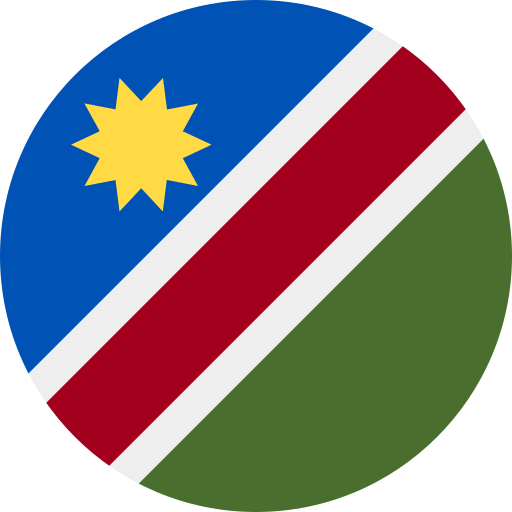 Namibia profile